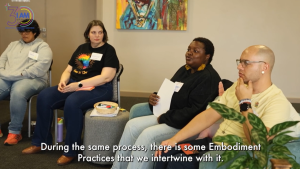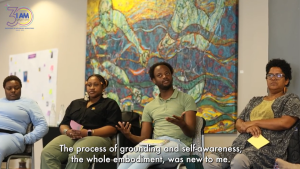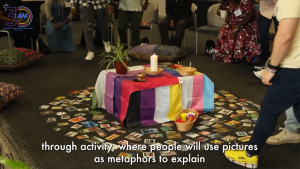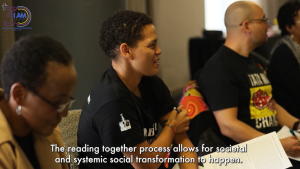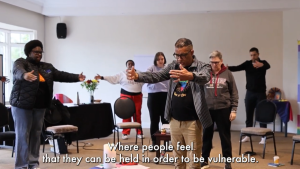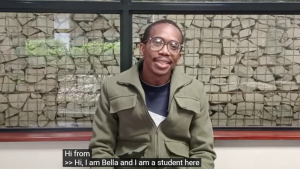

Over the past two weeks two of IAM’s staff members, Bianca and Louis, had the privilege of being part of a journey that brought together queer scholars from South Africa and Latin America in a vibrant South-South exchange. Supported by Act Church of Sweden and local partners, this initiative built on years of collaboration to amplify queer scholarship in the Global South. Our aim was not only to strengthen networks and contribute to movement building, but also to create space for the completion of a forthcoming co-edited volume that carries the voices of queer theologians into wider conversations.
This exchange took us across Brazil – first to the 9th Latin American Congress on Gender and Religion at Faculdades EST in São Leopoldo, followed by a writing retreat that nurtured our collective imagination, and finally to the first ReGeSex Symposium in Juiz de Fora. At each juncture, we were reminded that queer theology is not simply about producing academic work, it is about worldmaking – shaping spaces where dignity, belonging, and joy take root.
Queer Joy as Community Practice
One of the most moving insights came from Prof Charlene van der Walt, whose vision birthed this South-South encounter. Charlene reminded us, in the words of José Esteban Muñoz, that “queerness is not yet here”it is always on the horizon but it becomes real in community. In her words, theology is indecent, fragile, and messy, and ambiguity itself is sacred. Through moments of friendship, rest, and accompaniment during this trip, we were already embodying the future we hope for.
Muñoz calls this queer worldmaking: the practice of imagining and enacting worlds otherwise. Charlene has dedicated herself to this work, creating opportunities for emerging scholars, especially those at the margins, to find space, connection, and affirmation. Her work demonstrates that knowledge is not only produced in classrooms or in texts but also in circles of solidarity; shared meals; laughter and resistance.
Ubuntu and the Fullness of Humanity
Our exchange also reminded us of the power of African liberative frameworks such as Izitabane Zingabantu Ubuntu Theology. At its heart, this theology insists that queer people (izitabane) are fully human (zingabantu). It draws from Ubuntu’s ethic of interdependence – I am because we are – to affirm queer dignity, relationality, and belonging.
This theology pushes back against exclusionary Christian readings that have historically dehumanised LGBTQIA+ people. Instead, it reimagines faith as a space where queer lives are celebrated as integral to the fullness of humanity and the image of God. In the context of global exchanges, it offered us a language and ethic of solidarity, rooted in African soil yet resonant across the world.
Naming the Harm, Building New Futures
Of course, we cannot speak about queer joy without naming the realities that threaten it. Drawing from the powerful work of Rev. Alba Onofrio, Executive Director of Soulforce, our conversations highlighted how white Christian supremacy has shaped systems of domination, putting theology at the service of oppressive power. Soulforce highlights the impact and harm this has produced with helpful language and terminology:
- Spiritual violence, when faith is misused to deny someone’s sacred worth.
- Religious abuse, when power in spiritual communities is wielded to control or wound.
- Spiritual terrorism, when supremacist religious logics mobilise hatred against specific identities.
- Spiritual trauma, when people experience a profound rupture in their relationship with God or their spiritual foundations.
For queer people, these wounds are deeply familiar. Yet in our South-South exchange, we witnessed how naming these harms is itself an act of resistance. It creates space for healing, solidarity, and collective transformation. In the South African context, having constitutional rights does not mean that the struggle against injustice and discrimination is complete, as new the global Anti-Gender movement continues to impact local communities.
Building Movement through Exchange
At every step, this initiative was about more than academic output. It was about movement building. By bringing together queer scholars from different continents, we created a living network of care and resistance. We practiced what theologian Marcella Althaus-Reid might call indecent theology: theology that disrupts, that refuses to sanitise, that insists on locating God’s presence in the fragile, the messy, and the ambiguous.
We left Brazil with manuscripts to complete, yes – but more importantly, with friendships forged, visions expanded, and hope rekindled. We tasted what queer joy feels like when it is nurtured in community, when knowledge is shared as gift, and when theology is lived as worldmaking.
Gratitude and Commitment
As we look back on these two weeks, we are filled with gratitude: for Charlene’s relentless commitment to making space for emerging voices; for partners like Act Church of Sweden who recognise the importance of amplifying queer scholarship, and for each scholar who brought their story, their brilliance and their full selves into this exchange.
The work continues. The harms of spiritual violence and supremacy remain real. But through encounters like this, we are reminded that another world is already taking shape – one marked by queer joy, dignity, and belonging. And in this world, our theology is not only written on pages but embodied in friendships, in shared struggle, and in the sacred work of building futures together.